I built an audio plugin with Metacarp.
It’s a (deliberately) small CLAP effect with a text editor, a Compile button, and a status label. The editor contains one Carp function:
(sig process (Fn [Float] Float))
(defn process [x]
  x)
Audio enters, the function returns it unchanged, and everyone has successfully wasted a small amount of electricity.
Change the body like so:
(Float.* x 0.5f)press Compile, and the plugin becomes a gain effect. The
new function is compiled to native code and swapped in while the audio
keeps playing.
This is an unsupported experiment. It has one text box and no sensible audio features. But it’s also a metacarp compiler session living inside a digital audio workstation and replacing a function in real time, and I think that’s enough reason to show it off.
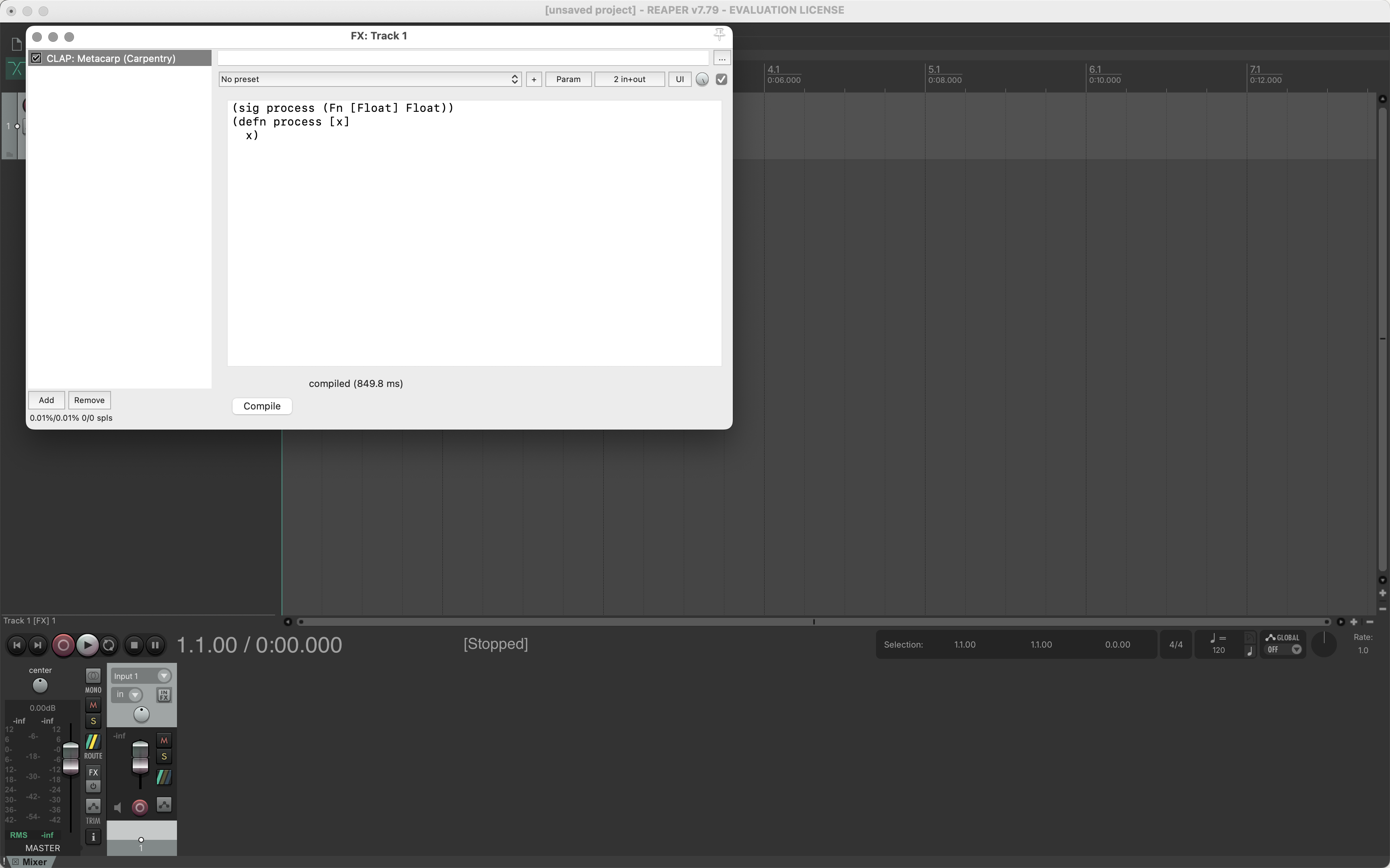
Let’s make some noise!
The plugin
The plugin has two main pieces.
A small Objective-C shell implements the CLAP ABI and a plain Cocoa interface. It receives audio buffers from the host, owns the editor and the button, and holds the address of the active Carp function. It’s also completely LLM-generated, because learning Cocoa didn’t seem like it would spark joy.
The engine is Carp. It owns a warm metacarp compiler session and a
persistent LLVM JIT. When the editor submits new source, the engine
treats it as a transient cell, runs it through the compiler, and asks
the JIT for the address of process.
The whole trip looks roughly like this:
Carp source
  -> warm Metacarp session
  -> what carp do (macros, inference, ownership, etc.)
  -> LLVM lowering
  -> persistent ORC JIT
  -> float (*)(float)
-> audio callbackThe only user-facing ABI I committed to is
(Fn [Float] Float). One sample goes in and one sample comes
out. It’s not a particularly good interface for an audio effect I’m
told, but it’s hard to misunderstand (mostly because it’s small) and it
invites experimentation.
It also means the first natural metacarp audio plugin is a bad volume knob. We’ll fix that in a bit.
The switcheroo
Compilation happens on a worker thread. When it succeeds, the plugin publishes the new function address through an atomic. When it fails, the address doesn’t change and the old function keeps running.
The audio thread loads the pointer at the beginning of a block and calls it for every sample:
fn = atomic_load(&active_process);

for (frame = 0; frame < frames; frame++) output[frame] = fn(input[frame]);The shell doesn’t do anything in the audio callback but load a pointer and make a very large number of small calls, which makes it predictable.
That little fn up there is deceiving, though, because it
ain’t as simple as it pretends to be.
The callback might have loaded the old address just before the worker publishes its replacement. Unloading that JIT generation right away would leave the audio thread executing potentially garbage memory. That’s bad for music and several other things (though very fun if you want to ROP gadget your way to success).
The plugin doesn’t quite bury its head in the sand, but it’s also not particularly clever. Successful generations stay resident until the plugin instance is destroyed. Every callback that already holds an old address can finish safely. The price is that pressing Compile slowly fills up executable memory.
A less lazy implementation would retire generations by epoch. Publish a new generation, wait until no callback can still be running the old one, then free it not on the audio thread. This is entirely achievable (a phrase I like to use for work I haven’t done and have no ambitions of doing).
The warm compiler
This whole thing only feels immediate because the compiler is meant to work with it. I’ve written about the session and the JIT before, but here’s a short refresher, because it’s cool and testing it was the main point of this challenge.
Metacarp loads and infers Core once, and the session, the LLVM
context, and the JIT all persist between edits. A new version of
process is compiled against that existing world and
published under a fresh native symbol. The plugin does minimal work for
every compiled function, even if that function happens to use a large
amount of standard library code.
On my machine, the bundle smoke test (also vibecoded) measured:
cold identity compilation       806.2 ms
warm gain replacement            63.3 ms
scalar JIT call 3.49 nsThe numbers don’t really matter here, but they’re far enough apart to make a coherent story I think. The cold compile is noticeable. The warm compile feels immediate enough for a button, and the indirect call per sample is cheap enough that it isn’t the silliest part of the design after all.
The same smoke test loads the actual plugin bundle without a DAW, constructs and activates it, sends audio through the identity function, and destroys it again. It turns out you can test a surprising amount of DAW code if you do it smartly! I had no idea, which is why I didn’t do it, the genie did.
Some actual noise
Playing with volume is not all that exciting, but even a stateless function on individual samples can do more than scale.
It can bend, for instance.
(sig process (Fn [Float] Float))
(defn process [x]
(* 0.2 (Float.tanh (Float.* x 32.0f))))This drives the signal hard and squashes it back into the range
[-1, 1], then I make it even smaller to pull th mixer out
of the red. Quiet samples get louder, loud ones flatten out. As such,
it’s a soft clipper, which is distortion in a nutshell.
Change the constants and press Compile again, and the drive changes live. That’s the first thing I made the plugin do that was actually fun to play with.
Prompts for the curious
Much here is left intentionally blank. I will probably not continue development on this, but I’d be interested to hear what other people come up with.
Stateful thoughts
The current function is pure and scalar. A useful effect needs parameters and usually some state: filters, delay lines, envelopes, oscillators, or at least something more interesting than a fixed curve.
State makes live replacement more fun. A new implementation might have a different state layout. The plugin then has to decide whether to throw away the old state, reinterpret it and pray, or run an explicit migration before the new function becomes visible to the audio thread.
I’ll leave that, too, as an exercise for the reader.
The sandbox
The plugin compiles code from a text box into the process of your digital audio workstation. There’s no sandbox.
Carp code can crash the host, access files, open sockets, corrupt memory, or take their sweet time in the audio callback. The shell avoids a lot of realtime sins, but it can’t prove that the function you give it is well-behaved.
How would an effective sandbox for VST code look like?
Platforms
Only the macOS interface exists. Instead of Cocoa, could it run on, say, Qt?
Bug roundup
I also know at least of some bugs:
- Plugin state isn’t saved, so the source buffer disappears with the instance.
- Successful native generations stay in memory indefinitely.
- Compiler work is serialized across plugin instances because some metacarp caches are process-global.
- The ABI only accepts
(Fn [Float] Float), and both stereo channels go through the same function.
There’s probably more, too, I just don’t know about it yet.
Fin
The plugin turns a float into another. It does so by keeping a compiler and an LLVM JIT inside the host, compiling Carp on demand, and atomically replacing native code while the audio thread keeps running.
That’s cool, magical, weird, wonderful, and extremely buggy.